Science is a journey of discovery
Sharing the scientific process with a broad audience is central to the mission of the Marlow Lab. As a science communicator and journalist, Dr. Marlow has reported on the people and projects behind remarkable findings around the world. Selected highlights of public talks, podcast interviews, and written articles are shown below.
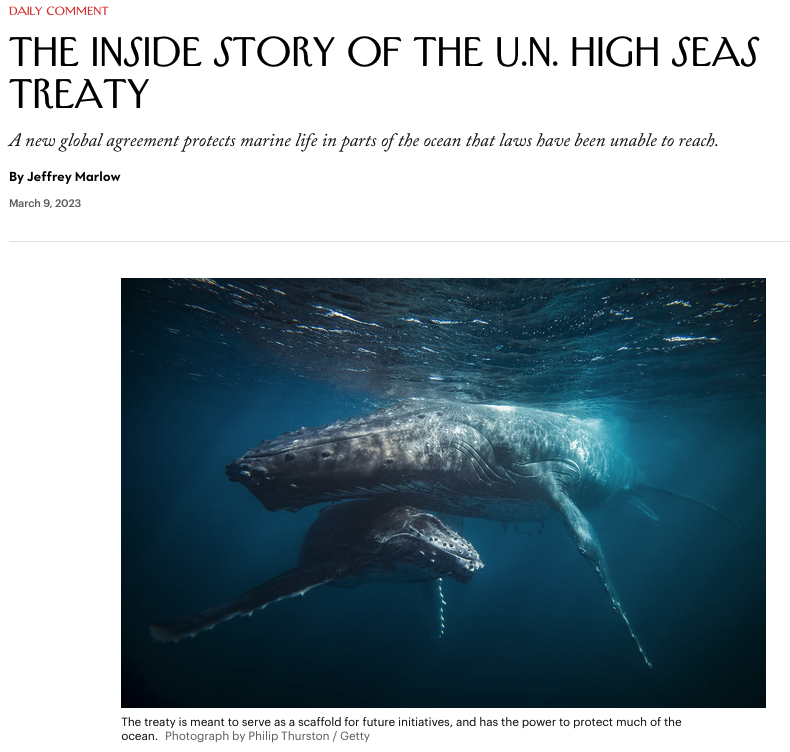
The New Yorker // The Inside Story of the U.N. High Seas Treaty
The United Nations recently passed a new treaty to govern nearly half of the planet’s area - the vast open ocean that belongs to no country, known as the high seas. The dramatic machinations that led to the completion of the treaty are recounted in [this article]. An excerpt:
“For the past five years, under the auspices of the U.N. Convention on the Law of the Sea, nearly two hundred nations have been haggling over the best way to change that. They agreed that the marine life of the high seas needed legal protection, in the form of a treaty—but how, exactly, might that protection be provided? Between 2018 and 2023, negotiators converged on U.N. Headquarters in New York for six meetings that each lasted two gruelling weeks, during which they worked their way through a litany of difficult questions. How should the high seas be studied, monitored, and protected? Who ought to profit from marine discoveries?”
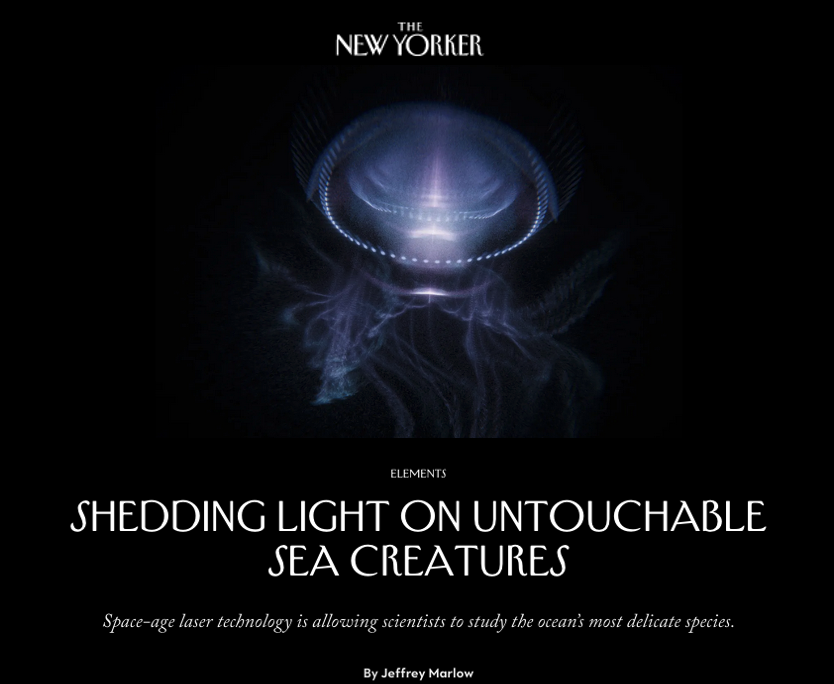
The New Yorker // Shedding Light on Untouchable Sea Creatures
The gelatinous organisms of the open ocean present a challenge for scientists: they’re often too fragile to sample, leaving us with little knowledge about how they move, behave, and interact with their surroundings. And yet, it seems that these creatures play key roles in a vast and understudied ecosystem, mixing nutrients throughout the water column and transporting organic carbon to the seafloor. [This article] features a new tool - and the engineer behind it - that turns the gelata’s “hardly-there” consistency into an unexpected strength, revealing remarkable biological structures in the process. An excerpt:
“Countless life-forms float, ethereal and gelatinous, between the sunlit shallows and the murky depths. Their daily migrations stir the ocean as much as wind or tides, and their falling corpses and waste feed life on the seafloor. But, because we lack the delicate technology to get to know them, we know vanishingly little about their behavior, their place in the food web, even their size and shape. Through the years, researchers have tried to engineer a softer touch—for example, with cages that fold underwater; foamy fingers controlled by hand-worn sensors; and futuristic, noodle-like strands that can cradle a creature—but even these innovations run the risk of reducing jellyfish to confetti. The very nature of these slippery creatures resists our advances; we can’t hold them lest we crush them in the embrace. How are you supposed to understand an animal that you can’t touch?”